

More Than Words
Why Clinical Terminology Matters


Standardised medical language provides a structured foundation for modern digital healthcare by ensuring that clinical meanings remain consistent across different technology platforms. While Hippocrates’ historical efforts began this journey, contemporary systems such as SNOMED CT now use logical relationships to convert medical records into computable data suitable for artificial intelligence. This semantic clarity is vital because naming errors or fragmented data can lead to dangerous clinical mismanagement and significant economic losses for health systems.
To bridge the gap between human clinical practice and technical data science, specialised clinical terminologists perform the essential work of authoring, mapping, and governing these complex vocabularies. These systems provide a deterministic grounding layer that reduces errors, supports advanced research, and enables the safe deployment of automated health tools. Ultimately, adopting universal terminological standards is a critical prerequisite for achieving a high-quality, interoperable, and future-ready digital infrastructure for healthcare.
Introduction
Terminology concerns language use and the definition of meaning. For most, this sounds niche—something for linguists or philosophers. But in healthcare, precise language can mean the difference between a patient receiving the right treatment and the wrong one. It also distinguishes health data that can be shared and acted upon from data that are kept in silos. As health systems adopt digital records and AI systems intended to assist with administration and frontline care, terminology must be treated as infrastructure, not an afterthought.
A Legacy of Language
Medical terminology has a long history. Some 2,500 years ago, Hippocrates and his followers developed the first structured vocabulary for diseases, procedures, and outcomes. Many words we use today, like symptom, diagnosis, therapy, and trauma, are attributed to their work. This vocabulary allowed medicine to shift from narrative superstition to a system of structured observation. This was not just about semantics; it formed the foundation for building, sharing, and advancing clinical knowledge.
Nowadays, we use digital records instead of parchment, but the need for shared clinical meaning remains. Incomplete or misunderstood clinical terminology can lead to medical mismanagement and patient harm.
A 2022 Lancet study found that up to 80% of surveyed patients with central diabetes insipidus (a fluid regulation disorder) had experienced a situation where healthcare staff had confused their condition with diabetes mellitus[1]. The 2009 case of Kane Gorny is the starkest example. He died from dehydration in an NHS hospital in London after his fluids were restricted due to this confusion[2]. Though extreme, this case shows the real dangers of imprecise language. Ultimately, this led to a campaign to rename the condition[3].
Confucius understood this long before the digital age:
“If names are not rectified, speech will not accord with reality.”
If we do not name things properly, things will go wrong.
From a Fragmented State of Nature to a Digital Commonwealth
In the 17th century, Thomas Hobbes wrote about the power of language and definitions. He spoke of speech as a means to transition man from his natural, isolated state to collaborative societies. Although his writings were political, we can use Hobbes’ philosophical framework as a lens to view our current situation. We want to move health data from fragmented to unified and need a shared contract on what words mean.
Healthcare workers across GP practices, hospitals, and countries record the same idea differently. Information quality varies. Medical records reside in digital infrastructure but are often split across systems. Silos and terminological differences cause meaning to leak when exchanging data. We can send humans around the far side of the moon, but sharing GP records across borders remains a challenge.
Semantic interoperability—what Hobbes called “apt imposing of names”—is not just a nice-to-have. It is essential to the NHS 10 Year Plan’s goal of a single, seamless patient record. It is also crucial to the European Health Data Space and to the deployment of AI. AI consumes structured meaning and needs an ontological framework to avoid hallucinations. Without semantic interoperability, we build on sand.
The Royal College of Physicians highlighted this in its digital and AI position statement. A lack of structured data and standardisation in electronic records is a major interoperability barrier and clinical risk. In its survey, 51% of respondents said data issues block clinical AI in the NHS[4].
What Are Clinical Terminologies?
ISO standard 17117 defines standardised clinical terminology as a systematically organised, computer-processable resource. It arranges words and phrases into concepts. The key point is that concepts are more than words. Concepts are the clinical ideas—the units of meaning—behind the language. If language changes, meaning remains.
Clinical terminologies come in two distinct flavours.
Interface terminology is used at the point of care. Clinicians enter it into a system, which then displays a readable format. Interface terminologies are flexible, localised, and user-friendly.
Reference terminology is the hub connecting the interface. It provides logical definitions and extensive content. Reference terminologies typically map to other standards and code systems.
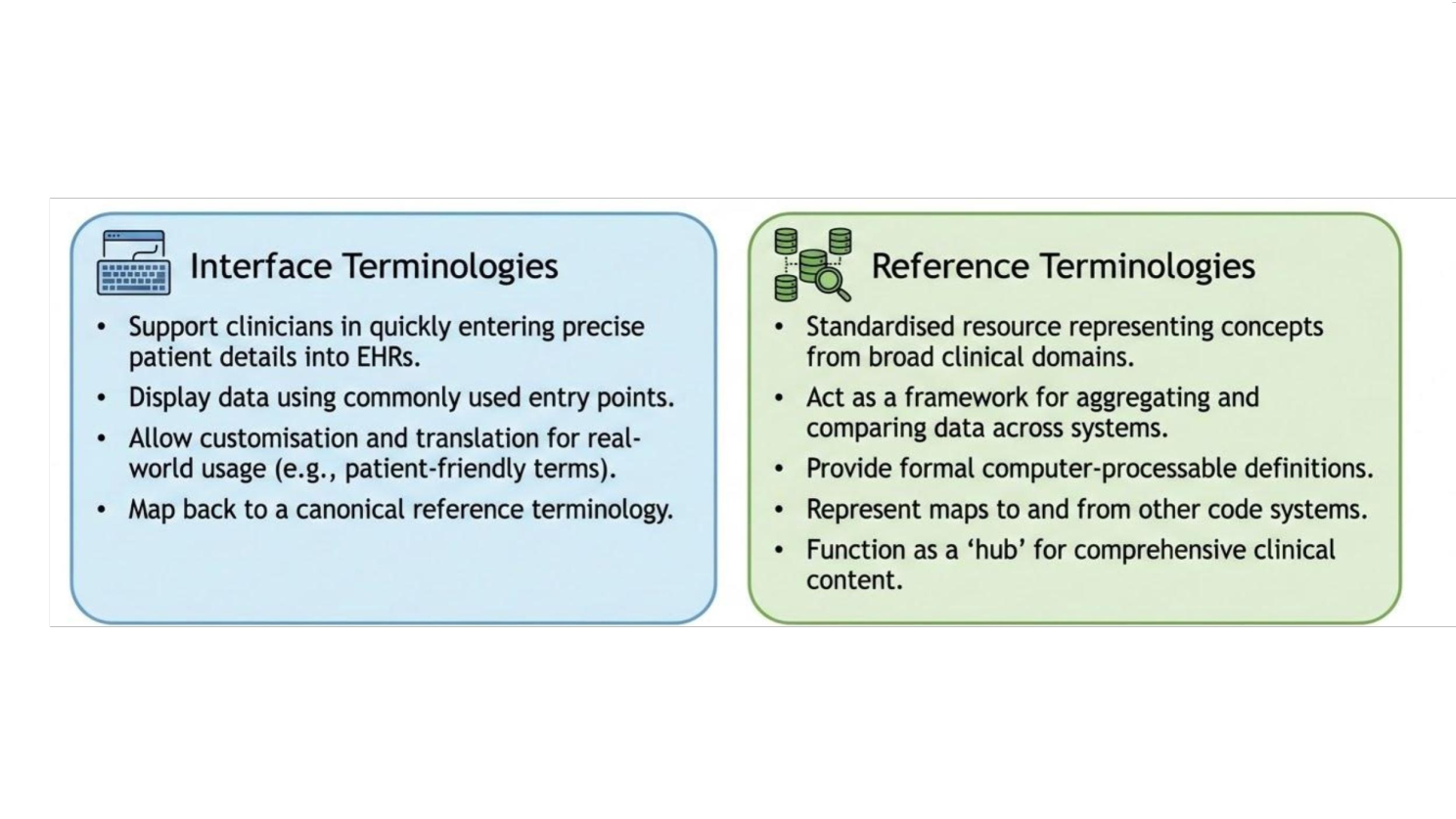
The two types work together. The interface helps clinicians enter data. The reference standardises how data is stored, managed, and analysed for clinical and administrative use.
SNOMED CT: Logic-Based Terminology in Practice
SNOMED CT is the most comprehensive clinical health terminology worldwide. It is used in more than 80 countries, is multi-lingual, and is logic-based. This last feature sets it apart from many other code systems.
SNOMED CT content consists of three main parts:
Concepts - each represents a distinct clinical idea and is assigned a unique numeric identifier
Descriptions - are the terms used in everyday practice by healthcare workers to order tests, document findings, and describe the care they give to patients
Relationships - the secret sauce. Logical, hierarchical links connecting concepts and enabling machines to reason over data
SNOMED CT uses a formalism called Compositional Grammar, based on description logic. Take appendicitis: the word breaks down into ‘append’ (appendix) and ‘itis’ (inflammation). Humans infer meaning this way. In SNOMED CT, the appendix is a |Finding site| and inflammation is an |Associated morphology|. This creates a computable definition for machines, and also enables a description logic classifier – a specialised reasoning tool – to automatically compute the hierarchical structure (subsumption relationships) of concepts within an ontology.
These hierarchies have the |Is a| relationship at their core. It represents parent-child relationships, showing one thing as a type of another, and encoding that relationship. SNOMED CT is polyhierarchical: a concept can have multiple parents and children, reflecting the multi-dimensional nature of medical knowledge.
The result: terminology that can power intelligent clinical decision support and not just flat code lookups.
📖 You can Read more about formal semantics in action in a previous article I wrote here
The Unseen Architect
Terminology does not maintain itself. Someone has to author, map, configure, and update these systems — and that work requires a very particular blend of skills.
ISO 22287 recognises three levels of clinical terminologist: technical specialist, specialist, and advanced specialist. In practice, many organisations rely on a single person covering elements of all three.
Terminologists sit at the intersection of clinical expertise and technical knowledge. On the clinical side, most come from nursing, medicine, pharmacy, allied health, or health information management backgrounds. They understand clinical language, how it is documented in systems, and how the resulting data is intended to be used. On the technical side, they work with terminology servers, authoring platforms, and mapping tools, alongside standards such as HL7 FHIR. They are familiar with principles such as Cimino’s Desiderata and know when to pre- or post-coordinate. Critically, they are also facilitators — running governance meetings, negotiating between clinical and digital teams, and translating requirements into implementable solutions.
📖 For a deeper dive into the role of the terminologist, refer to my previous article on the topic here
The day-to-day work falls into several streams.
Authoring
Mapping
Release Management
Implementation & Tooling Support
Quality Assurance
All of these areas warrant an in-depth article of their own, but authoring and mapping are the two least recognisable to non-specialists.
Authoring
When a new concept is required — a new disorder, procedure, drug, device, etc. — the terminologist evaluates the request, thoroughly researches the domain, constructs a formal definition using appropriate relationships and attributes, adds all relevant synonyms, and prepares it for inclusion in a future release. It is painstaking, expert work — and when it is done well, it is largely invisible to the clinicians and systems that depend on it.
Mapping
Translating codes between vocabularies to allow data to move between environments. The classic example is SNOMED CT to ICD-10 for billing and reporting. Precise one-to-one matches are the goal, but achieving perfect equivalence is not always possible when design structures and use cases differ; the terminologist must determine the most appropriate and meaningful fit. Maps must also be re-validated with every release, as the source terminology evolves.
📖 More articles on mapping
What Terminology Is Not
A common misconception: terminology is not the same as clinical coding. Both involve encoding health data, but terminologies aim to capture clinical reality at the point of care. This allows real-time analytics and interoperability. Clinical coding, such as ICD-10, summarises past events for statistical and administrative purposes.
They are complementary tools, not competitors — each serving a distinct purpose in the information lifecycle from point of care to population-level reporting.
📖 Read more about the role of the clinical coder in a previous article I wrote here
The Cost of Getting It Wrong
Information sharing and semantic clarity matter for their own sake. But rigorous terminology governance also makes economic sense, in addition to considerations of patient safety.
Poor terminology governance drives medical errors, lost revenue, and missed data-sharing opportunities. Lack of interoperability introduces risk through information gaps. Patients must repeat their history to each new clinician, risking omission of key details. An OECD study found these patients show a 15% drop in trust in their clinician. This shows patient satisfaction declines when information flow is poor.
The same OECD study estimates the cost of misdiagnosis, underdiagnosis, and overdiagnosis at 1.8% of GDP. For the UK, that could mean up to £55 billion in cash terms[5,6].
The benefits of doing it right are just as big. Frontier Economics estimated that patient data sharing in the EU is worth €10.7 billion each year. This includes a 14% rise in clinical trial activity and 64,000 extra quality-adjusted life years for cancer patients[7].
Closer to home, an NHS trust in London piloted an SNOMED CT-assisted coding tool. They identified missing conditions in 35% of inpatient spells and made coding improvements in nearly half of the cases[8]. This means more than better reimbursement. There is better visibility, resource allocation, and patient safety. Proper terminology governance stops the garbage-in, garbage-out cycle.
Terminology Must Be an Upfront Consideration
Modern healthcare ambitions — single patient records, AI-enabled care, seamless cross-border data exchange — all depend on standardised clinical terminology. It improves consistency in frontline documentation, powers clinical decision support, supports safer information exchange, and enhances the accuracy and integrity of clinical datasets. The financial and patient safety implications of poor terminology governance are real and quantifiable.
As AI systems become increasingly embedded in clinical workflows, the need for a reliable semantic foundation becomes more urgent, not less. Terminologists are doing the essential, often invisible work of making data semantically reliable — providing the ontological framework that supports grounded, trustworthy intelligent systems.
The key message is this: terminology must be considered from the outset of any digital health project, not retrofitted once problems become visible. Having terminology expertise present from the start prevents costly rework later — and, more importantly, protects the integrity of the data on which clinical decisions and, increasingly, AI recommendations depend.
Conclusion
Standardised medical language provides a structured foundation for modern digital healthcare by ensuring that clinical meanings remain consistent across different technology platforms. While Hippocrates’ historical efforts began this journey, contemporary systems such as SNOMED CT now use logical relationships to convert medical records into computable data suitable for artificial intelligence. This semantic clarity is vital because naming errors or fragmented data can lead to dangerous clinical mismanagement and significant economic losses for health systems.
To bridge the gap between human clinical practice and technical data science, specialised clinical terminologists perform the essential work of authoring, mapping, and governing these complex vocabularies. These systems provide a deterministic grounding layer that reduces errors, supports advanced research, and enables the safe deployment of automated health tools. Ultimately, adopting universal terminological standards is a critical prerequisite for achieving a high-quality, interoperable, and future-ready digital infrastructure for healthcare.
Author: Michael Harwood-Jones AdvFEDIP FHRIM MBCS
Michael is a specialist in controlled clinical vocabularies with almost two decades of experience in health classification, terminology, and information standards. His background includes roles in hospital administration, informatics, internal audit, education, and standards development.
Additional references:
[1] https://www.thelancet.com/journals/landia/article/PIIS2213-8587(22)00219-4/abstract
[2] https://www.bbc.co.uk/news/uk-england-london-18814487
[4] https://www.rcp.ac.uk/policy-and-campaigns/policy-documents/the-rcp-view-on-digital-and-ai-report/
[6] https://commonslibrary.parliament.uk/research-briefings/sn02783/
[7] https://www.frontier-economics.com/uk/en/news-and-insights/news/news-article/?nodeId=20346
[8] https://www.magonlinelibrary.com/doi/abs/10.12968/bjhc.2022.0135